



People sometimes ask how I use AI in sermon preparation. The short answer is that it comes in late. By the time I open a tool, most of the work that decides where the message is going is already done.
Where I start
I start with prayer. Anyone sincere about their calling or the gravity of ministry knows that’s where the work begins. I’m seeking to discern the mind of God for this text and this congregation. When I sense a direction, I write down what I’m feeling and then I pray again before I move on.
Then I read the passage, and I read it again, several times. I sketch out a general plan, the direction I feel the Lord leading. It’s a rough draft at that point, and it should be.
Next I try to understand the passage in its own world. I consult proven and reliable sources. I study the manners and customs of the culture it was written in. I want to know what the writer intended and what his first readers would have heard. Until I have a solid feel for that, I’m not ready to talk about what it means to me or my people.
Only after I’ve gained traction on these questions do I begin to flesh out how it applies to the people I serve.
Where AI comes in
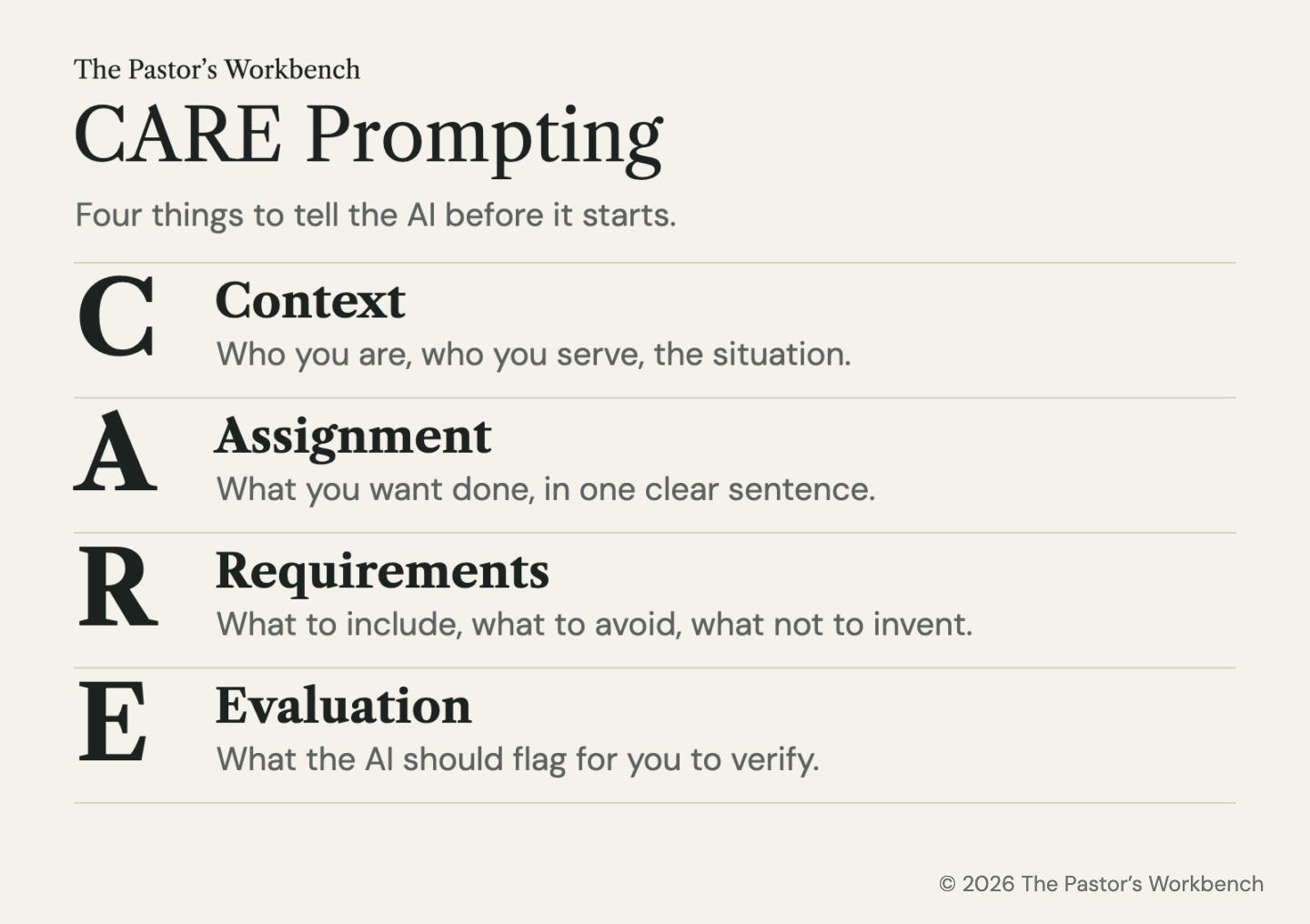
After all of that, I build a prompt using CARE. The Context carries my own working understanding of the passage, what I’ve seen in the text and what I’ve learned about its setting. So the tool I use always works from my study.
If CARE is new to you, here are the four parts in one place.
From there AI serves as a research assistant. I’ll ask what older commentaries like Jamieson, Fausset, and Brown or Matthew Henry say about a verse. I’ll ask for historical background from biblical sources and from extrabiblical historians like Josephus. Then we work through it in rounds, sharpening the questions as I go.
Why I keep this order
If you open the tool first, it gets to frame the passage for you. It will hand you a main idea, and maybe an outline, before you’ve formed a single observation of your own. Those suggestions are hard to unsee. What happens is you end up evaluating its reading, when you should be forming your own understanding.
If you’ve prayed, read and studied first, you can tell when a suggestion fits the text and when it’s reaching and offering more than the text actually says. You have something to check it against.
Here’s a practical caution too. When you ask AI what Matthew Henry or Josephus said, it will probably give you a confident summary, or even a quotation. The problem is, it isn’t always in the source. These works are old and easy to find online, so always check them before you use anything. Find the passage in the commentary itself, or in a standard translation of Josephus, and read it there. If it isn’t where the tool said it would be, by all means, leave it out.
Try it this week
Before you open any tool on next Sunday’s passage, pray over it and read it several times. Write down what you notice and what you don’t understand yet. Then bring those notes into your CARE prompt as Context, and see how much better the answers get when the tool starts from your study.
The free Pastor’s Workbench community has Contextual and Interpretive Passage Study in 02 Study & Teach, with a Basic Passage Study Worksheet for exactly this first pass. Join the free community and start there.